save 10% When purchasing two or more stories using the code2STORIES10


Time management for children: 7 steps to teach them the value of a day without pressure
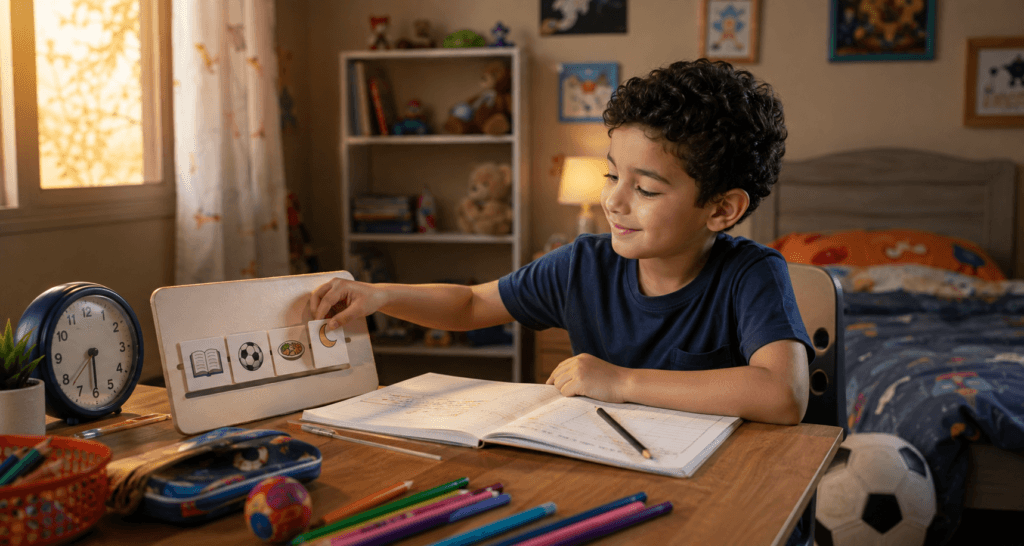
Children don't perceive time the way adults do; five extra minutes with their favorite toy can feel like an eternity, while half an hour of studying drags on endlessly. And when their mother asks them to get ready to go out, they might suddenly stop to gaze at an old toy or start asking endless questions.
This behavior doesn't always mean the child is careless or deliberately ignoring instructions; rather, it means they haven't yet learned to appreciate the passage of time and transition from a favorite activity to a required task. Therefore, it begins Time management for children By helping them understand their day, not by forcing them to follow a busy schedule similar to those of adults.
Why is time management important for children?
Grant Time management for children This fosters a sense of stability because the child becomes more able to anticipate what will happen during the day, knowing there is time for studying, time for playing, resting, and sleeping. It also helps them gradually take on responsibility and reduces daily conflicts related to homework, school preparation, and tidying up their toys.
But the goal is not to turn the child into someone who runs after a list of tasks, but to teach him that there is room in the day for what needs to be done and what he likes to do, if he learns how to prioritize.
1. Make time something the child can see.
Phrases like "in a little while" and "hurry up" may not be clear, especially to young children. They can be replaced with tangible tools, such as an hourglass, a visual timer, or a picture chart showing the order of the day's activities.
Instead of repeatedly asking your child to tidy up without specifying a time limit, say something like, "We'll tidy up the toys until the timer goes off, then we'll read the story." Time management for children An experience they can understand, not mysterious orders.
2. Create a simple schedule together.
It's best to create a schedule that includes only essential tasks, such as waking up, eating, going to school, doing homework, playing, and sleeping. Drawings and colors can be used with younger children.
It is important for the child to participate in setting the schedule and choosing the time for some activities, because his participation makes him more willing to commit to it.
3. Don't fill the child's entire day
Time management doesn't mean dividing every minute between school, studying, and exercise. Children need free time to play without a plan; because play helps them discover their interests, develop their imagination, and learn to make decisions.
Therefore, you must gather Time management for children Between responsibilities, rest, movement, and play, a successful schedule is not the busiest, but the most balanced and sustainable.

4. Break down large tasks into steps.
The phrase «finish your homework» may seem heavy on a child, while it is easier for him to carry out small instructions, such as: «Open your math book, complete the first question, then take a short break.».
Breaking down the task reduces the child's feeling of pressure, gives him a sense of accomplishment after each step, and makes him more prepared to move on to the next step.
5. Give him a chance to choose
Parents can set clear boundaries, then give the child some freedom within them; for example, choosing whether to start with Arabic language homework or mathematics, or specifying the activity he wishes to do after finishing.
The choice helps in success Time management for childrenBecause it makes the child a partner in organizing his day instead of him feeling that everything is imposed on him.
6. Use stories and games
Children learn best when they see the idea within a situation similar to their world. You can read a story about a hero who was able to organize his tasks and reach his goal, then ask the child: "What was the first thing the hero had to do?".
Stories not only provide information, but also help to instill values. Educational values for children In a fun and indirect way, especially when the child sees himself within the events and talks about the hero's decisions.
7. Be a role model in respecting time.
It is difficult for a child to learn to respect appointments in a home where there is haste and procrastination, or where he hears his parents asking him to put down the phone while they are busy with it all day.
Parents can share a simple plan with their child, such as, "I'll finish this chore, and then we'll play together." Children observe what we do more than they listen to what we say.
And it indicates UNICEF It is important to establish a regular routine, encourage habits of completing tasks, and help children set goals, plan, and manage their time and effort.
What do you do when a child doesn't comply?
Not every day will go according to schedule; the child might be late, forgetful, or refuse to finish an activity they enjoy. In this case, it's not necessary to label them as lazy, but rather to understand the reason for the delay: Was the task too long? Were they tired? Or did they need a reminder before moving on?
The plan can be modified instead of penalizing him for every delay; because Time management for children It's a skill that requires practice and patience, like reading and riding a bicycle. True success doesn't mean a child accomplishes the most tasks, but rather learning how to balance their responsibilities and leisure without losing the joy of childhood.
Read also: Values Child education: 7 qualities children don't learn through commands